Insights & Commentary
Investment Letter – June 2026
Following the Value Downstream
Welcome to our June Investment Letter.
In this month's letter:
- With the Australian dollar looking overvalued against its long-term declining trend, we explain why we're unwinding our currency hedge after a gain and returning to unhedged global shares.
- We also take our AI thesis downstream: having taken profits on semiconductor exposure, we ask where the value of ever-cheaper intelligence finally settles, and why the answer may be the platforms that own the data and workflows where it's put to work.
- Plus, a review of The New Geography of Innovation.
PORTFOLIO COMMENTARY
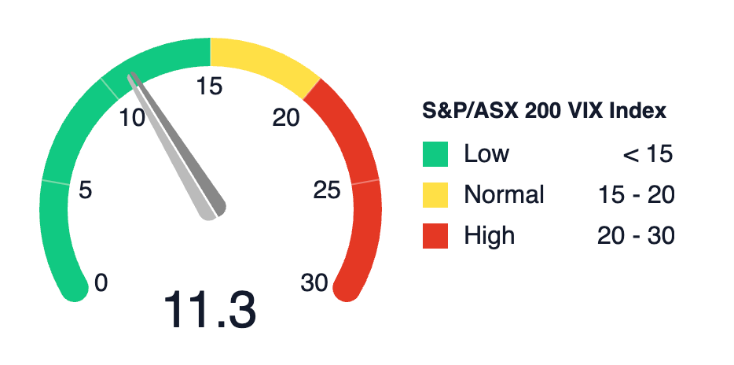
The Australian market is quite calm right now. The volatility index is sitting just below its average over the past 15 years of data.
Figure 1: Australian Volatility Index sits just below its 15-year average
GLOBAL SHARES REMAIN THE FAVOURED GROWTH ASSET CLASS
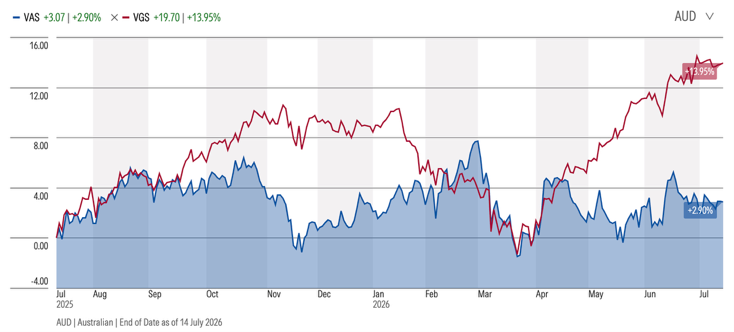
But share markets have been volatile over the past 12 months. Figure 2 illustrates this clearly: Australian shares rose by roughly 4%–8% in each of four distinct waves, and on three of those occasions the gains were followed within weeks by sharp falls that pushed the market back into negative territory.
Global shares have also been volatile, but that volatility has been biased toward much stronger gains and significant outperformance relative to Australian shares.
Global shares quite simply are a much stronger engine of earnings growth than Australian shares and for this reason we remain materially overweight to global shares in portfolios.
Figure 2: Australian Shares (VAS ETF) lag Global Shares (VGS ETF) over the past 12 months
 Source: Morningstar as at 14 Jul 2026
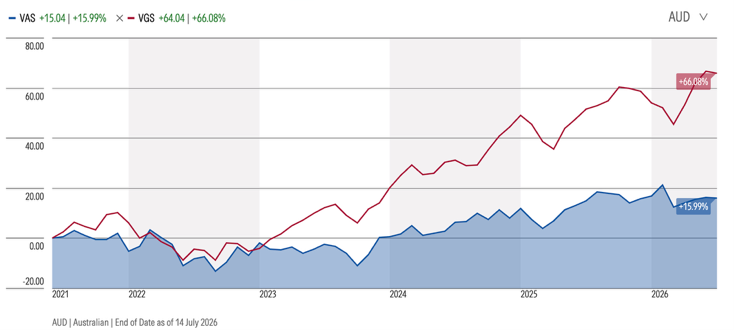
This point is clearer when you view the medium to long-term investment returns in global shares compared to Australian shares. The chart below shows the significant outperformance of global shares relative to Australian shares over longer time periods.
Figure 3: Global Shares (VGS ETF) significantly outperform Australian Shares (VAS ETF) over the medium to long term
 Source: Morningstar as at 14 Jul 2026
THE CURRENCY HEDGE HAS DONE ITS JOB
Just over a year ago, we tactically increased currency hedging across our core international shares. At the time, we believed the Australian dollar was likely to strengthen and that this could hold back the returns of unhedged global investments.
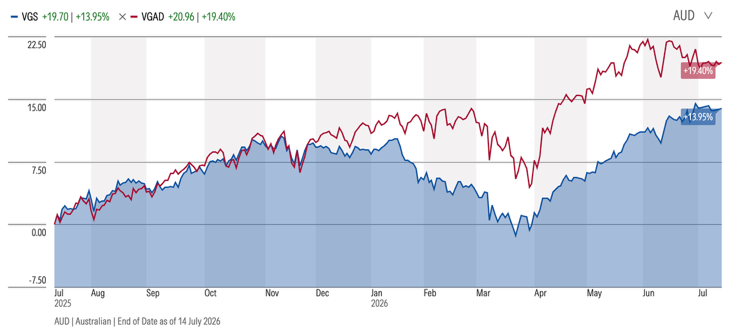
That decision has worked well. As Figure 4 shows, over the past year the currency-hedged Vanguard Global Shares ETF (VGAD) returned around +19%, compared with approximately +14% from the unhedged VGS ETF. The difference largely reflects the rise in the Australian dollar.
Figure 4: Currency Hedged Global Shares ETF (VGAD) outperformed the unhedged version of the same ETF, VGS
 Source: Morningstar as at 14 Jul 2026
We now believe the picture is changing. The Australian dollar has strengthened materially and looks overvalued relative to Australia's economic outlook. Local economic growth remains modest, households continue to face cost-of-living pressure and the property market is slowing. By comparison, the stronger US economy continues to attract global capital, particularly into technology, AI and infrastructure.
The hedge was a tactical decision, not a permanent position. Having benefited from the rise in the Australian dollar, we believe it has now largely done its job. We are therefore progressively removing these currency hedges and returning more of the portfolio to unhedged global shares.
A weaker Australian dollar from here would provide an additional boost to the value of these international investments.
A LONGER TERM STRUCTURAL VIEW OF THE AUSTRALIAN DOLLAR
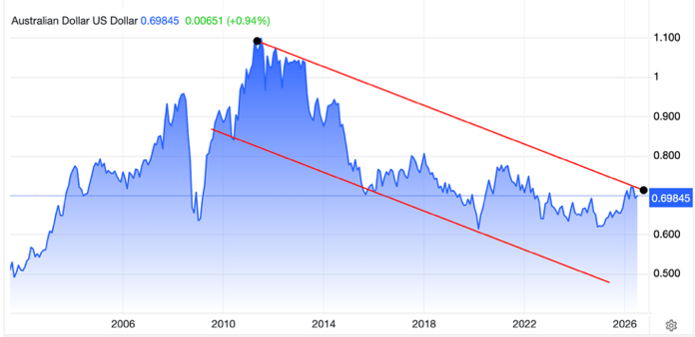
The longer-term chart in Figure 5 also helps explain our thinking. Since the peak of the mining boom more than a decade ago, the Australian dollar has moved in a broad declining trend.
Figure 5: Australian Dollar Looks to be in a Structural Decline Since Peaking in 2011
 Source: tradingeconomics.com
Back then, rapid growth in China and very strong demand for Australian commodities provided exceptional support for the currency. Those conditions are no longer as powerful today.
The recent strength in the Australian dollar has also been broader than simply a move against the US dollar. Its trade-weighted value, which measures the currency against a basket of Australia's major trading partners, has also risen materially. This suggests the Australian dollar has experienced a broader appreciation.
As the chart shows, the currency has now moved towards the upper end of its longer-term declining trend. In our view, this leaves less room for further strength and increases the risk of a weaker Australian dollar from here.
This structural picture further supports our decision to progressively remove the currency hedges and increase exposure to unhedged international shares.
WHY UNHEDGED GLOBAL SHARES CAN PROVIDE PROTECTION IN A MARKET SELL-OFF
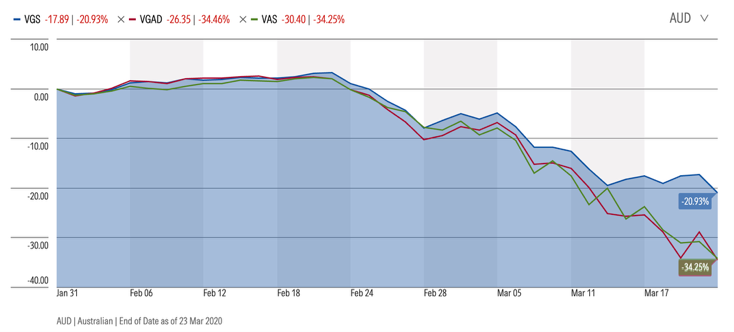
The chart in Figure 6 shows the experience during the sharp COVID-19 sell-off in early 2020. Australian shares fell around -34%, while currency-hedged global shares also declined by around -34%. By comparison, unhedged global shares fell by around -21%.
Figure 6: Global Shares (Unhedged) held in Australian Dollar terms can outperform their overseas peers during market sell-offs.
 Source: Morningstar
The important difference was the Australian dollar. During the market panic, the Australian dollar weakened sharply as investors moved towards the US dollar. For Australian investors holding unhedged global shares, this lifted the Australian-dollar value of their overseas investments and cushioned a meaningful part of the market decline.
This also highlights why we maintain a greater allocation to global shares. Global investments give portfolios exposure to a much broader range of economies, industries and companies than the Australian market. When combined with unhedged currency exposure, they can also provide an additional source of diversification during periods of severe market stress.
It does not mean global shares will always fall less than Australian shares, but the chart is a good example of how broader global exposure and currency diversification can help make portfolios more resilient.
In the next section, we share our view on how AI is evolving as an investment opportunity, moving beyond the simplistic boom-or-bust commentary often presented in the media.
Share prices reflect the market's assessment of the commercial value that companies and technologies are expected to generate. The more effectively that value is protected, controlled and converted into earnings, the more durable those earnings are likely to be—and the greater the potential for sustained shareholder returns.
MARKET OUTLOOK
WHERE DOES THE VALUE OF AI FINALLY SETTLE?
Every major technology boom begins with a shortage. During the railway boom, it was track and rolling stock. During the early internet era, it was telecommunications capacity, servers and network equipment.
Today, the shortage is computing power. Advanced semiconductors, memory, data centres, electricity infrastructure and the large AI models sitting on top of this physical capacity have become the immediate bottlenecks of the artificial intelligence boom.
Our portfolios have benefited from this phase of the cycle, and we have recently taken profits on part of that exposure, a decision we explain below.
But the more important question shaping our thinking is a different one: Where does the economic value created by artificial intelligence ultimately settle? We do not believe the answer will necessarily be where the value is being captured today.
DEMAND IS OUTRUNNING SUPPLY
The scale of the demand surge is becoming increasingly visible.
Google has reported direct customer use of its first-party AI models rising from around 7 billion tokens per minute to more than 16 billion tokens per minute in roughly six months, with more than 330 cloud customers each processing over one trillion tokens during the past year.
OpenAI has separately reported its APIs processing more than 15 billion tokens per minute. Although these figures cannot simply be added together, they tell the same story: the consumption of machine intelligence is increasing at an extraordinary pace.
Epoch AI, an independent research institute, estimates that aggregate AI computing capacity is expanding at roughly 3.4× per year, while token demand appears to be growing closer to 10× per year.
In an industry evolving this rapidly, no single forecast should be treated as definitive. However, the direction is clear: demand for AI inference is growing considerably faster than the infrastructure available to support it.
This helps explain the enormous investment in semiconductors, data centres, electricity and networking infrastructure.
When demand arrives faster than supply can respond, the economics of the bottleneck become exceptional. Prices remain firm, new capacity is absorbed quickly and companies providing the scarce resource earn abnormal profits.
THE PRICE OF INTELLIGENCE IS FALLING
Our starting point is that the potential demand for artificial intelligence may be almost open-ended.
During the early days of the internet it would have been almost impossible to forecast the eventual demand for digital data. As storing, transmitting and processing information became cheaper, entirely new industries emerged: streaming, cloud computing, online marketplaces, social media and digital payments.
AI may follow a similar path, but the economic unit becoming cheaper is arguably much more profound.
That economic unit is intelligence itself.
The Stanford AI Index estimates that the cost of using GPT-3.5-level intelligence declined from roughly $20 per million tokens in late 2022 to around $0.07 by late 2024— a reduction of more than 99% in less than two years.
More recent research suggests that the cost of obtaining a given level of AI capability may currently be declining between five and ten times each year, although the rate naturally varies by application.
The important price is not the cost of one token. The relevant measure is what it costs to obtain useful intelligence—to analyse legal documents, answer customer enquiries, review medical data, or write and test software.
That cost continues to decline rapidly because:
- Chips are becoming faster and more energy efficient.
- Smaller AI models increasingly match much larger ones.
- AI software continues to improve.
- Models require fewer computational resources to produce high-quality results.
The result is a powerful economic dynamic.
Consider an AI task that currently costs $50,000 to perform and is therefore practical only for the largest organisations.
If the cost falls by a factor of ten, thousands more businesses can justify using it. Reduce the cost by another factor of ten and the capability simply becomes embedded inside everyday software.
This is why we believe placing a fixed ceiling on AI demand is the wrong framework. As intelligence becomes cheaper, the number of valuable applications expands dramatically.
FROM TASKS TO WORKFLOWS
At its simplest, AI combines language models, data and computing power to automate tasks such as writing, summarising reports, reviewing contracts and producing software code.
This is also the part of the software market most vulnerable to disruption. Applications whose value lies only in performing isolated tasks may become increasingly replaceable.
Businesses, however, do not operate through isolated tasks. They operate through connected workflows.
An invoice is received, matched with a purchase order, inventory is updated, approvals are completed, accounting entries are created and financial forecasts change automatically.
Thousands of these workflows operate simultaneously across finance, HR, logistics, operations, suppliers and customers.
Enterprise software exists to coordinate these workflows. These systems contain the data, enforce the rules, control permissions and integrate departments across entire businesses.
WiseTech, for example, coordinates extremely complex global logistics involving freight forwarders, ports, customs authorities, warehouses and shipping companies across multiple countries.
The value of these systems is not that they perform one task. Their value comes from coordinating thousands of connected workflows.
This leads to an important part of our AI thesis. AI does not destroy software uniformly. Instead, it changes where the value of software ultimately resides.
The simpler the task, the greater the risk that AI reproduces it directly.
However, as workflow complexity, regulatory requirements, integrations and proprietary data increase, the software environment itself becomes more valuable.
AI may complete individual tasks within the workflow, but the platform still determines where the data lives, who has authority, what rules apply and how every action is recorded.
The more complex the coordination problem, the less useful intelligence becomes without a trusted environment in which to operate.
AI AS AN INPUT, NOT THE FINAL PRODUCT
Many investors are focused on companies selling AI. We believe the largest pools of economic value may ultimately emerge within businesses that receive intelligence as an increasingly inexpensive input.
Consider an enterprise software company. Historically, improving its products required large development teams, significant engineering effort and lengthy release cycles.
AI has the potential to change both sides of this equation.
On the cost side, developers become more productive by writing, reviewing and testing code more efficiently. Product teams can prototype features faster, while experimentation becomes significantly less expensive.
On the revenue side, software products become increasingly intelligent and personalised. A logistics platform can identify bottlenecks unique to a customer's supply chain. Accounting software can predict cash-flow issues before management identifies them. Property platforms can provide increasingly tailored recommendations for buyers and sellers.
Software gradually shifts from recording what has already happened toward helping customers decide what should happen next.
This creates a powerful flywheel. Development costs fall, innovation accelerates, products become more intelligent, customer value increases and providers gain greater pricing power.
Revenue can increase while operating costs decline.
One company's technology deflation becomes another company's productivity advantage.
Hyperscale platforms are already exceptionally well positioned for this transition.
Microsoft, Alphabet and Amazon do not merely own computing infrastructure. They also own cloud platforms, software ecosystems and global distribution networks.
They can use AI internally to reduce costs while simultaneously improving the products and services they sell to customers.
More activity generates more customer data, deeper insights and increasingly intelligent products, while the cost of producing that intelligence continues to decline.
Our portfolios already maintain measured exposure to these businesses through diversified global equity investments and quality-focused international holdings.
However, our attention increasingly extends beyond the largest technology companies toward industry-specific workflow businesses such as WiseTech, Xero, REA Group and CAR Group.
These businesses own valuable combinations of proprietary data, customer relationships and deeply embedded workflows.
They are certainly not immune to disruption, but we believe the market may be making the mistake of treating all software companies as though AI will affect them equally.
AI may replace simple software tasks while simultaneously increasing the value of platforms that coordinate complex business environments.
THE VALUE POOL IS MOVING
We do not believe the upstream AI infrastructure cycle is necessarily over.
Given today's imbalance between supply and demand, infrastructure providers may still enjoy attractive earnings growth for some time.
However, successful investing requires separating two important questions:
- Will AI demand continue to grow?
- Who will retain the abnormal profits created by that demand?
We have much greater conviction in the first question than the second.
History consistently demonstrates that exceptionally profitable bottlenecks attract new competition and investment.
Additional semiconductor capacity is built. More data centres are constructed. Electricity infrastructure expands. Technology improves and customers seek lower-cost alternatives.
Eventually, supply catches up with demand.
The infrastructure remains essential, but the scarcity returns earned by its providers gradually decline.
Telecommunications provides an excellent historical example. Demand for data grew exponentially, yet advances in technology and increased competition continued reducing the cost of transmitting each unit of information.
AI infrastructure may follow a similar path. The infrastructure remains critical, but more of the economic value migrates toward businesses using that infrastructure most effectively.
Initial value belongs to the infrastructure bottleneck. Long-term value often belongs to those solving valuable business problems.
WHAT WE ARE DOING IN PORTFOLIOS
This thinking has direct implications for our portfolios.
We have benefited from exposure to the upstream AI infrastructure cycle through carefully managed positions in global growth investments.
Those investments performed exceptionally well, allowing us to progressively realise profits and, where appropriate, completely exit certain positions.
This is not because we believe AI demand is about to disappear. The evidence suggests exactly the opposite.
Rather, share prices anticipate future returns, and disciplined investing requires recognising when much of an attractive investment thesis has already been reflected in valuations.
We are not abandoning our AI investment thesis. Instead, we are beginning to follow the value pool downstream.
Our attention is increasingly turning toward the owners of workflows, proprietary data and industry software platforms that coordinate complex economic activity.
Interestingly, many of these businesses have experienced meaningful share-price weakness as investors worry that AI may disrupt their business models.
In some cases those concerns may prove justified, particularly for simple software applications. However, we believe the market is not yet fully distinguishing between basic software tools and deeply embedded workflow environments.
That distinction is extremely important.
We continue monitoring a number of these businesses closely. Our preference may ultimately be to obtain exposure through diversified technology ETFs rather than attempting to identify a single winner.
As always, valuation remains critical. A strong investment theme does not automatically represent a good investment at every price.
For now we remain patient. The businesses are on our watch list, the thesis continues to develop and we will wait for attractive opportunities before increasing exposure.
THE FINAL DESTINATION OF AI VALUE
The first phase of the AI boom was relatively straightforward to understand. The world suddenly required enormous computing power, supply could not keep pace and companies controlling the bottleneck benefited significantly.
The next phase will be much harder to identify because it occurs inside businesses, inside workflows and across industries.
AI will perform more tasks, coordinate more processes and become increasingly integrated into everyday business operations.
We do not believe every software platform simply disappears. In many cases AI may actually make those platforms considerably more valuable.
The businesses owning the data, controlling the rules and coordinating the workflows may become the places where the economic value of cheaper intelligence ultimately settles.
The question increasingly shaping our investment thinking is simple:
When intelligence becomes dramatically cheaper, who owns the environment where that intelligence is put to work?
We believe the answer to that question may define the next phase of the AI investment cycle.
BOOK REVIEW – THE NEW GEOGRAPHY OF INNOVATION
 Author: Mehran Gul
Publisher: William Collins
Author: Mehran Gul
Publisher: William Collins
While thinking about where the value of artificial intelligence may ultimately settle, we recently finished reading The New Geography of Innovation by Mehran Gul.
The book proved particularly relevant to the ideas discussed throughout this month's investment letter.
Although the book is presented as a study of geography, it is fundamentally an exploration of why certain places repeatedly create world-leading technologies while others struggle to do so.
Through conversations with entrepreneurs, scientists, investors and policy makers across countries including the United States, China, Germany, Singapore, Switzerland, South Korea and Canada, Gul examines what separates enduring innovation ecosystems from isolated success stories.
THE CORE IDEA
The central argument is that breakthrough companies rarely emerge because of one brilliant individual.
Instead, they grow from ecosystems that combine talent, universities, venture capital, infrastructure, culture and the continuous flow of ideas between people and organisations.
One of the book's most memorable analogies is that companies are like seeds.
A seed can only flourish when planted in healthy soil.
Great farmers don't simply grow crops— they grow soil.
Silicon Valley is perhaps the clearest example.
Popular history often celebrates entrepreneurs building companies from garages. Gul argues that the real competitive advantage came from something much larger: world-class universities, venture capital, research institutions, employee mobility and dense professional networks that allowed knowledge to circulate rapidly.
Silicon Valley became more than a collection of technology companies. It became an innovation network.
As one technology cycle ended and another began, the ecosystem continually reinvented itself— moving from semiconductors to personal computers, software, the internet, smartphones and now artificial intelligence.
FROM GEOGRAPHIES TO DIGITAL ENVIRONMENTS
While Gul focuses on physical innovation hubs, we believe the same principle increasingly applies inside the digital economy.
Enterprise software platforms increasingly act as digital ecosystems where data, workflows, customers and business processes interact.
These environments become progressively more valuable as intelligence becomes cheaper.
Artificial intelligence can automate tasks, but it still requires trusted environments containing structured data, governance, permissions and workflows before it can consistently deliver value inside organisations.
This reinforces the investment thesis discussed earlier in this letter.
We believe the enduring value of AI may not belong solely to those creating intelligence, but increasingly to those owning the environments where intelligence is deployed.
OUR TAKEAWAY
The New Geography of Innovation provides a thoughtful framework for understanding why innovation clusters emerge and why they continue producing world-class businesses over decades.
More importantly, it encourages investors to look beyond individual technologies and instead focus on the environments that repeatedly create, support and commercialise innovation.
We believe this perspective aligns closely with the next phase of artificial intelligence, where ownership of data, workflows and digital ecosystems may become increasingly valuable as intelligence itself becomes cheaper and more widely available.
Thank you for reading our June 2026 Investment Letter.
If you have any questions regarding your portfolio or would like to discuss any of the themes covered in this month's commentary, please don't hesitate to contact our team.