Insights & Commentary
Investment Letter – October 2026
Growth, Risk and the Price of Progress
Welcome to our October Investment Letter.
This month, we examine the contrasting fortunes of Australian and global share markets, the pressures facing Australian households, and the economic pulse from substantial investment in technology and infrastructure.
We also consider three concerns weighing on financial markets: private credit, the enormous investment in artificial intelligence, and rising government bond yields.
Throughout, we return to a familiar investment principle: remain invested, diversified and disciplined, while recognising that economic progress rarely follows a straight line.
Portfolio returns remain positive on a rolling 12-month basis, although performance has come under pressure in recent months.
The Reserve Bank has raised interest rates four times in 2026, taking the cash rate to 4.60%, its highest level since 2011. Central banks elsewhere have also turned: the US Federal Reserve raised rates in September for the first time since 2023, and the European Central Bank has raised rates twice this year.
Successive rate increases tend to act as a brake on share markets, and that brake has fallen hardest on rate-sensitive and domestically focused investments. Australian REITs (listed commercial property) have been under pressure in our portfolios, and the broader weakness of the Australian share market has also weighed on returns this year, as we discuss in the next section.
We expected 2026 to be a volatile year, as we flagged in our 2025 letters and again in April.
Australian Shares Need a Broader Growth Engine
Australian shares have made little headway over the past 12-month period shown in Figure 1, while global shares have delivered substantially stronger returns.
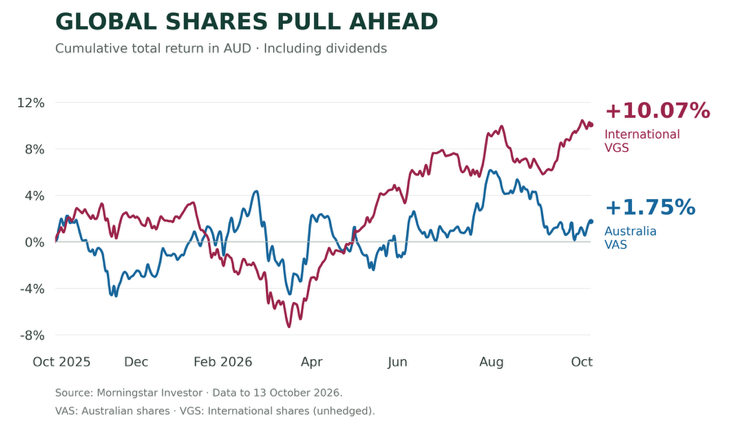
In our view, this divergence reflects the length and depth of global value chains, with distinct profit pools that companies can tap into at different stages, from enabling investment and supplying technology to manufacturing and serving the end consumer.
Australia’s value chains are comparatively shorter and shallower, with more of the sharemarket’s profit pools sitting closer to the consumer, leaving earnings more dependent on households’ capacity to spend.
The Australian share market is struggling to find its next gear. Higher living costs and interest rates have constrained household spending, making revenue and earnings growth harder to achieve for businesses exposed to domestic consumption.
Figure 2 on the next page illustrates the extent of the pressure. Across every state and territory, the mortgage repayment burden is substantially higher than it was before the pandemic. In NSW, median mortgage repayments now represent roughly 30% of average household earnings, compared with around 17% in 2020. Queensland has also experienced a particularly sharp increase.
It is worth sitting with this graph for a moment and appreciating the sheer magnitude of the change in just one, albeit significant, component of household living costs. It offers some perspective on the financial strain under which many Australian households now find themselves.
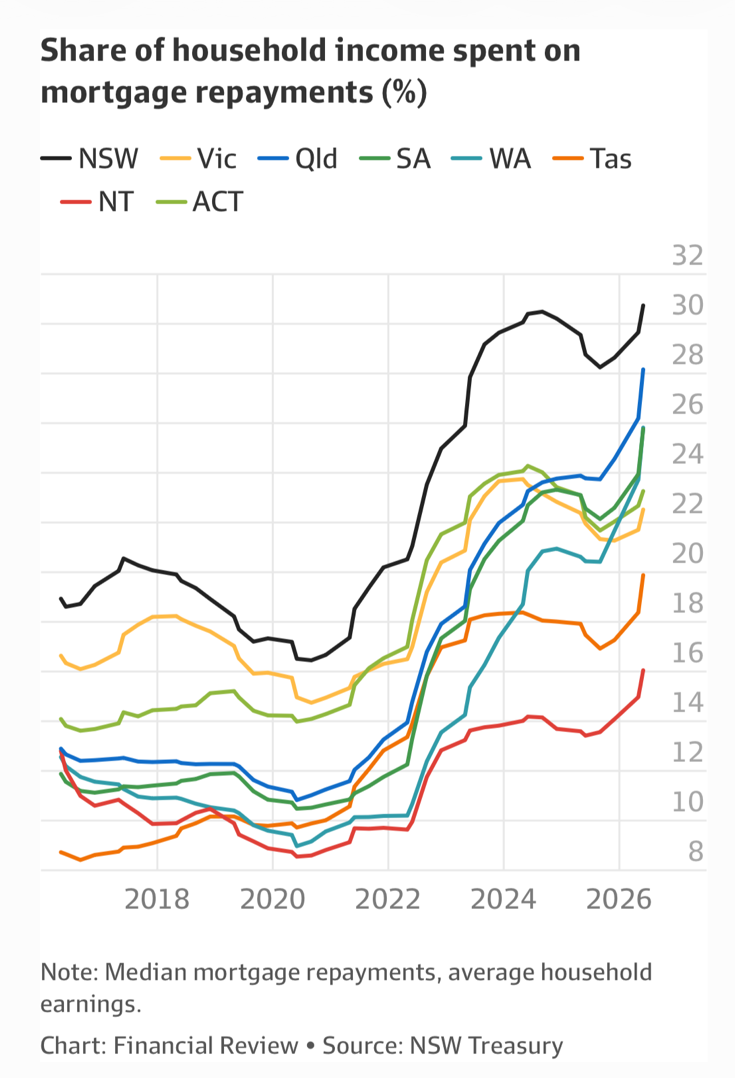
Source: AFR, NSW Treasury. Measure: median mortgage repayments relative to average household earnings.
There is also a growing sense of public frustration, even anger, at the inability of political leaders to meaningfully ease the cost-of-living pressures that have persisted for several years.
We were reminded of this recently during an ordinary conversation with a warm and friendly waitress at our local café. A single mother, she spoke, with very little prompting, about the considerable stress she was experiencing simply trying to secure rental accommodation. She was still waiting in a long queue, with little certainty about what lay ahead.
As the conversation unfolded, her anguish became increasingly apparent, eventually giving way to palpable anger towards politicians whom she felt had failed people in her circumstances. What struck us was that this did not feel like the usual passing complaint about the cost of living. There was something deeper in her frustration, a sense of exhaustion, insecurity and perhaps a loss of faith that those in authority understood the difficulties of ordinary people.
The graph captures the financial pressure in numbers. Conversations such as this remind us of the very human consequences behind those numbers.
For households servicing a mortgage, this leaves less room for discretionary spending. The pressure therefore extends beyond household budgets into the revenues and margins of businesses competing for the remaining consumer dollar. When profit pools sit close to the consumer, a stretched household budget becomes a constraint on corporate earnings.
However, subdued spending by a significant share of Australian households does not necessarily mean the economy is heading into a recession.
Government expenditure and investment in infrastructure, defence, technology and the energy transition are supporting economic activity, even as households remain under pressure. These forces are keeping the economy moving, although the benefits are uneven. Economic resilience does not automatically translate into the broad-based earnings growth needed to underpin a sustained rise in the Australian share market.
This is where the longer value chains and greater variety of profit pools available in global share markets matter. International markets offer a much wider range of companies supplying the technology, equipment and services behind these investment programmes. These businesses tap into profit pools upstream of the end consumer, generating orders from investment and production without first needing a recovery in household spending. For them, capital expenditure is a direct source of revenue and potential profit growth.
The portfolio implications
We see this broader opportunity set in global stocks as one major reason for the performance gap illustrated in Figure 1, although valuations and currency movements also influence returns.
There are two implications for our portfolios. First, diversification should extend beyond geography to the underlying sources of earnings. Owning businesses across investment, production and consumption reduces our reliance on any single economic driver. It cannot eliminate volatility, but it can help spread risk more effectively.
Second, we continue to favour meaningful global share exposure because of the breadth of long-term growth opportunities available. That opportunity must still be weighed against the price we pay: a strong structural theme does not make every associated company an attractive investment.
Australian shares nevertheless retain an important place in our portfolios, providing income, exposure to local businesses and a closer connection to clients’ Australian-dollar spending needs. Retaining that allocation alongside global investments helps balance growth opportunities with currency and market risks.
Our aim is to combine different sources of return so that portfolios can participate in growth without relying too heavily on one country, one sector or one economic outcome.
Three Concerns Weighing on Financial Markets
Financial markets are rarely short of things to worry about. We thought of sharing a list of worries that have captured the market’s attention over the past ten years, but the list became too long to share here. And yet markets have continued to move forward.
Some concerns are entirely justified, while others become exaggerated, and many eventually give way to developments, adjustments and solutions that were not apparent when the concerns first emerged.
At present, there are three issues attracting considerable investor attention: private credit default risks, the enormous capital expenditure associated with artificial intelligence and the returns it might ultimately generate, and rising government bond yields.
Each deserves serious consideration, but equally, each needs to be placed in perspective.
1. Private Credit – An Old Lesson in a New Setting
The recent collapse of Sydney-based property developer Bathla Group, established in 1997, has once again brought the risks of private credit into sharp focus. After almost three decades in business, the developer entered administration in August 2026, with approximately $3 billion in known creditor claims, including substantial borrowings from private credit providers rather than traditional banks.
The fallout has extended to numerous private credit investment funds and their investors, with some funds restricting withdrawals as they assess their exposures and potential losses.
It raises an obvious question: why were traditional banks, with their considerable lending experience, extensive credit-assessment capabilities and established risk controls, not providing more of this financing to the likes of Bathla?
Banks may have judged that the risks associated with some developments were simply not commensurate with the potential rewards.
Much of the financing of residential development in Australia in recent years has instead come from private credit funds. These funds attracted investors with attractive income returns. The problem arose when investors began to view the higher yields offered by these investments as an attractive alternative to conventional defensive assets, without adequately recognising the additional credit default, concentration and liquidity risks they may be assuming.
Higher returns are rarely offered without a reason.
In credit markets, the additional yield is compensation for bearing additional risk, not a gift.
Ultimately, the income from any lending arrangement must be supported by the commercial realities of the underlying borrower and the assets or business activities that generate the cash flow. A property development does not become less risky simply because its financing has been repackaged into an investment fund promising an attractive monthly distribution.
Importantly, the Reserve Bank of Australia, in its October 2026 Financial Stability Review, assessed that the risks posed by Australia's private credit market to the broader financial system remain contained. Despite considerable growth, the sector remains relatively small, accounting for less than 2% of financial-system assets, with limited direct connections to the banking system.
For investors, the lesson is to resist the temptation to pursue unusually attractive returns without considering whether they are sustainable within the normal risk-and-return characteristics of the asset class and the commercial realities of the underlying assets.
These episodes are hardly new. They recur through successive economic and credit cycles, often once or twice over the course of an individual's working and investing life. The circumstances and financial products change, but the underlying human behaviours remain remarkably familiar.
Some investors absorb the lessons, adapt, grow wiser and emerge stronger. Others, having suffered painful losses, retreat from investing altogether and never realise the full potential of their accumulated capital.
Such is the ebb and flow of economic and investing life. It offers opportunity, but guarantees nothing and owes no one anything.
For our part, we have not directly invested in Australian private credit funds.
2. Artificial Intelligence – The Limits of Prediction and the Boundlessness of Human Endeavour
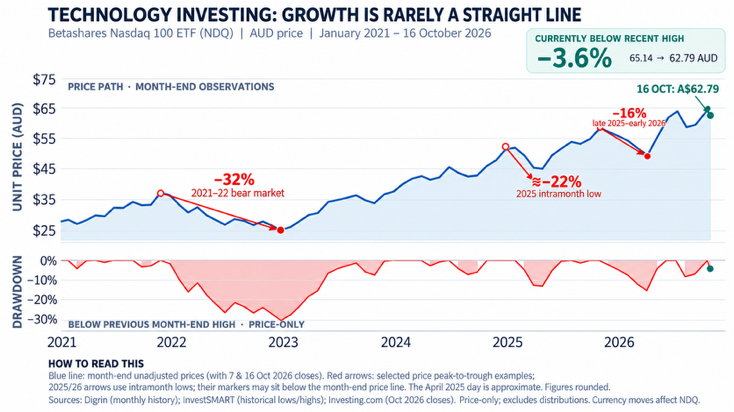
Source: Morningstar
Let us briefly review the most talked-about sector in the market: technology. Figure 3 tracks the Nasdaq 100 ETF (NDQ) in Australian dollars. US technology stocks make up a significant share of global share indices, and they have experienced three material retracements over the past six years. In mid-October, the ETF was around 4% below its early-October peak.
The lesson is not that every decline should be dismissed, but rather that volatility is a recurring feature of investing in growth businesses. The more important distinction is whether a decline reflects a temporary reassessment of valuations and expectations or a lasting impairment of underlying earnings prospects.
To that end, the saga of speculative commentary on AI’s earnings potential continues.
Will the enormous investment in artificial intelligence ultimately generate sufficient returns to justify the expenditure, or will it become another chapter in the long history of speculative overinvestment?
It is a legitimate question, particularly as hundreds of billions of dollars are committed to data centres, semiconductor manufacturing, computing infrastructure and energy capacity. Investors are understandably concerned about the eventual return on invested capital, the growing use of debt to finance expansion, and the possibility that expectations have moved ahead of commercial reality.
The reality is that we simply do not know the full extent of AI's possibilities, and at this stage, we cannot know.
The recently abandoned initial public offering of Australian AI infrastructure business Firmus Technologies provides an interesting example of the evolving approach to financing AI businesses.
The company sought to raise approximately $7 billion at an indicative valuation of around $44 billion, before withdrawing its planned ASX listing on 9 October following insufficient investor support.
Much of the criticism centred on the substantial valuation being sought relative to the company's limited existing operating capacity, the considerable capital required to deliver its expansion plans, and questions about the proposed transaction structure and the potentially large returns to early investors.
There has also been an element of the familiar Australian debate about whether we are too quick to dismiss ambitious entrepreneurs (perhaps the scars left by the ambitious entrepreneurs of the 1980s, and a smaller group during the GFC, have not fully healed; see this month’s book review), particularly those attempting to build businesses in industries where Australia has relatively little established experience. James Packer, himself an investor in Firmus, captured this sentiment, remarking that the difference between America and Australia is very noticeable in the way Australia tends to tear down aggressive entrepreneurs and America builds them up.
Perhaps there is merit in that concern. Experience is valuable, but prior experience in a particular industry cannot always be a prerequisite for achievement, especially when entirely new industries are being created. The history of technology is filled with entrepreneurs who ventured beyond established boundaries and built businesses that subsequently transformed the world.
Nevertheless, the withdrawal of the Firmus IPO also demonstrated something reassuring: financial markets can exercise restraint. Investors were not prepared to accept every valuation simply because a company was associated with artificial intelligence.
There is no contradiction between admiring a company's ambitions and declining to invest at the price being requested. It is also worth asking whether the valuation reflected the incentives of the IPO process as much as the business itself.
In any case, Firmus may yet build a successful and substantial business. It may return to public markets, perhaps overseas, or secure the private financing required to advance its plans. Time will tell. Its failure to list in Australia does not establish that its ambitions are misplaced, just as a successful listing would not have established that the proposed valuation was justified.
There is, however, a broader issue for Australia. We should aspire to participate more meaningfully in the development and ownership of the industries shaping the future, rather than remain spectators to some of the most consequential economic and technological developments of our time.
That requires an ecosystem capable of financing experimentation, accepting the possibility of failure and supporting promising businesses over long periods. It does not require investors to abandon valuation discipline or overlook financial and execution risks.
A mature investment culture should be capable of both encouraging extraordinary ambition and asking difficult questions about the price of participating in it.
Our Investment Approach
We believe investors should maintain meaningful exposure to the industries shaping the future, while recognising that our imagination and forecasting abilities will inevitably fall short of the possibilities that eventually emerge.
The alternative, directing capital exclusively towards the familiar industries of the past, carries its own considerable risks.
Nothing stands still. Established industries must continually adapt as competition, new technologies and substitutes reshape their economics. Some will successfully reinvent themselves; others will experience diminishing returns as their traditional sources of profitability come under pressure.
Our preferred approach is to participate in emerging structural growth opportunities through a diversified portfolio of established, globally competitive businesses, particularly those with strong balance sheets, substantial cash-generating capabilities, technological expertise, entrenched market positions and access to large international markets.
These characteristics do not eliminate investment risk, nor do they remove the need to be disciplined about valuations. They do, however, provide important safeguards, giving businesses the financial capacity to invest, experiment, absorb disappointments and adapt as technology evolves without relying excessively on the continued generosity of capital markets.
The resulting volatility in share prices is something investors must be prepared to endure. It is often the price of participating in industries where the ultimate outcomes remain uncertain and where progress itself rarely follows a straight line.
We do not need to know precisely where artificial intelligence will lead to recognise its potential to reshape the economic landscape. Nor do we need to invest indiscriminately in every new company promising to benefit from it.
We need to remain invested, diversified, disciplined and open to possibilities that cannot yet be fully imagined.
3. Rising Government Bond Yields – A Sign of Strength or Stress
Government borrowing costs have risen sharply across much of the developed world. This reflects several forces coming together: substantial government borrowing requirements, persistent inflation and growing competition for capital from businesses, particularly those investing heavily in artificial intelligence and related infrastructure.
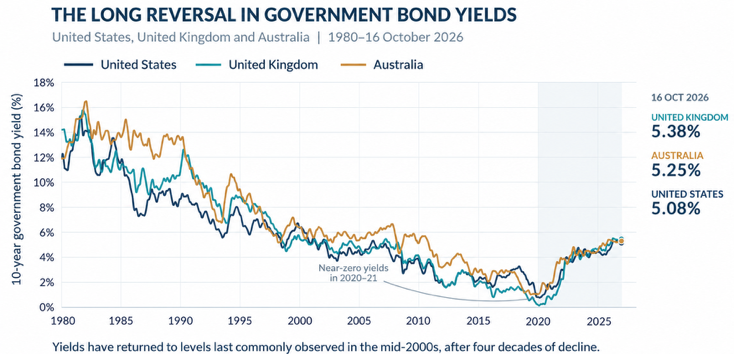
Source: tradingeconomics.com
But are higher government bond yields necessarily a problem? And, if so, for whom?
There are broadly two ways of interpreting this development.
The first is relatively constructive. Economic growth remains resilient, businesses are investing and corporate profits are expanding, particularly in the US. There are reasonable grounds to expect further productivity gains as investments in artificial intelligence and energy infrastructure begin to deliver their benefits. In such an environment, the demand for capital naturally increases, and investors require higher returns to commit their money over longer periods.
Governments also stand to benefit from stronger economic growth. As we have discussed in previous letters, growth in nominal GDP can help reduce government debt relative to the size of the economy, provided debt does not grow even faster. This improves the capacity of governments to manage their existing obligations and potentially undertake further investment. We emphasise that economic growth is the most constructive path available to governments to enhance borrowing capacity to continue funding rising costs of ageing populations and other major initiatives.
The second interpretation is less reassuring. Perhaps investors are becoming concerned that borrowing by governments and corporations is excessive, that some investments will fail to deliver adequate returns, or that inflation and growing debt burdens will make lending increasingly exposed to default risk. They may consequently demand higher interest rates or, in more extreme circumstances, decline to provide funding altogether.
So, which of these explanations is currently supported by financial markets?
One useful observation comes from the composition of government bond yields. The increase in US Treasury yields during 2026 has been driven predominantly by higher real yields, the inflation-adjusted returns investors require, rather than a substantial increase in long-term inflation compensation.
Indeed, while current inflation remains elevated, the market's implied average inflation rate over the coming decade remains relatively contained, at approximately 2.3%. This suggests investors have not abandoned confidence in the longer-term inflation outlook.
We would not interpret higher real yields as inherently negative. They may reflect expectations of stronger economic activity, higher future real interest rates and increased competition for capital. Equally, some of the increase could reflect investors demanding greater compensation for the uncertainty associated with lending over long periods.
There is also a plausible longer-term path to lower inflation. As the benefits of AI become more widely adopted across businesses, and investments in energy generation, electrification and power storage mature, productivity gains could improve economic capacity and help moderate inflationary pressures. The timing and scale of those benefits remain uncertain, but they should not be overlooked when assessing the longer-term outlook.
The second observation concerns the actual willingness of investors to lend.
Here, there are some clear pockets of concern. The bonds of AI infrastructure provider CoreWeave in the U.S. have recently traded at yields of approximately 15% per annum, reflecting considerable investor anxiety about its borrowing commitments and capacity to generate sufficient cash flows. In Australia, the withdrawal of Firmus Technologies' proposed stock market listing provides another example of investors becoming more demanding about the valuations and financing of capital-intensive AI businesses.
These are meaningful warning signs. They suggest the market is becoming more discerning about which businesses deserve capital, and on what terms.
Importantly, however, such caution has not become universal.
Credit spreads on US investment-grade corporate bonds remain relatively tight and likewise in Australia, suggesting investors are not yet anticipating widespread corporate defaults. Credit remains available to established, financially sound businesses, even though the absolute cost of borrowing has increased. Government bond markets, particularly US Treasuries, have also continued to attract investors seeking safety when concerns about AI financing have intensified.
Higher borrowing costs nevertheless create challenges. They increase the cost of refinancing for governments and businesses, raise the hurdle for new investment projects and place pressure on borrowers whose cash flows are insufficient to support their debt. They can also weigh on equity valuations as investors demand higher prospective returns.
Our reading of the evidence is that bond markets are signalling a higher cost of capital rather than a generalised loss of confidence in borrowers. There are signs of excessive risk-taking in particular areas, but not yet of a broad credit contraction.
Higher interest rates can be a natural consequence of resilient growth and strong investment demand. The greater danger emerges when the cost of capital rises beyond what borrowers can reasonably earn or afford to service.
For now, the evidence suggests markets are becoming more selective, rather than indiscriminately withdrawing capital. That is not necessarily an unhealthy development.
One Final Signpost from Market History
We have shared these charts in previous letters and revisit them as one final signpost for this month’s letter.
Drawn from several decades of market history, they illustrate recurring patterns in equity returns across the US presidential election cycle and within individual calendar years.
History is not a reliable timetable for future returns, but these patterns provide an additional perspective as we assess current market conditions and look towards 2027.
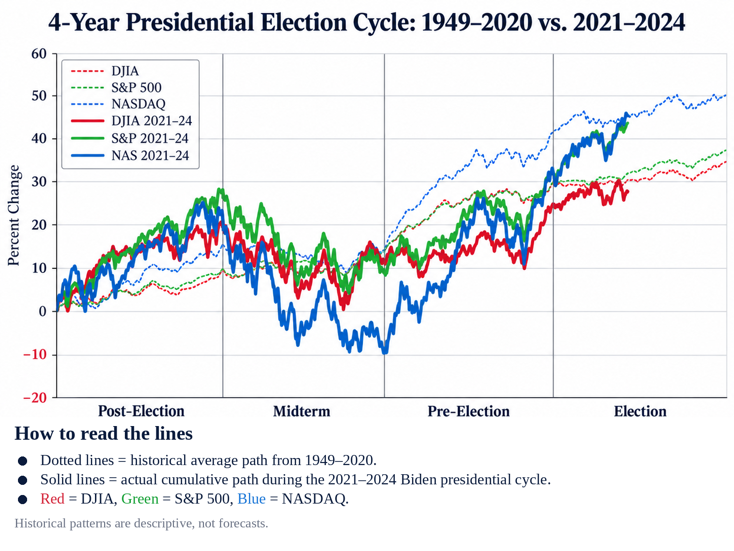
Source: Stock Trader’s Almanac 2026
The chart in Figure 5 illustrates a recurring pattern in US equity markets across the four-year presidential election cycle. Historically, the second year (midterm year) has tended to experience greater volatility and weaker returns, followed by a stronger recovery in the third (pre-election) year.
The 2021–2024 Biden presidential cycle broadly reflected this pattern, with weakness in 2022 followed by a substantial recovery in 2023 and 2024. While history offers no guarantees, the pattern provides another useful signpost as we approach the end of 2026 and look towards 2027.
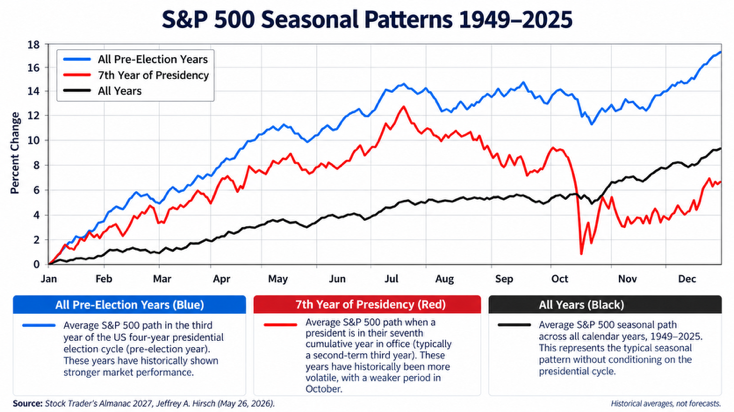
The second chart in Figure 6 offers a more detailed perspective on seasonal market patterns. Historically, the S&P 500 has delivered considerably stronger returns in pre-election years than in an average calendar year, particularly towards year-end.
However, the seventh year of a presidency has shown a more volatile and less favourable pattern, including pronounced weakness around October. That October weakness rests on a small number of years and is heavily influenced by the 1987 crash, which fell in the seventh year of the Reagan presidency. Interestingly, 2027 falls into both categories: it is a pre-election year and the seventh cumulative year of Donald Trump’s presidency. His non-consecutive terms, however, have no precedent in this record. Again, while these historical tendencies are not forecasts, they provide another useful reference point as we consider the outlook for 2027.
Book Review – The Eighties – The Decade That Transformed Australia

Author: https://www.amazon.com.au/Frank-Bongiorno/e/B001KDXKT4/ref=dp_byline_cont_ebooks_1
Publisher: Black Inc.
Australia's prosperity today owes much to decisions made four decades ago. In The Eighties, historian Frank Bongiorno takes us back to a remarkable period when Australia began its transformation from a relatively protected, inward-looking economy into one increasingly integrated with the rest of the world.
The Hawke and Keating governments presided over some of the most consequential economic reforms in modern Australian history, including the floating of the Australian dollar, financial deregulation and the progressive dismantling of protectionist policies. These changes helped lay the foundations for a more competitive and internationally engaged economy.
But Bongiorno's account is far more than an economic history. He brings to life the politics, personalities, cultural changes and extraordinary corporate excesses of the period. It was the age of Alan Bond, Christopher Skase and spectacular entrepreneurial ambition, but also financial collapses, displaced workers and considerable social upheaval.
What makes the book particularly worthwhile is its refusal to present economic reform as an uncomplicated success story. The benefits were substantial, but unevenly distributed, and often accompanied by considerable human costs.
For investors, there is a broader lesson. Economic transformation is rarely orderly. Periods of innovation, deregulation and expanding opportunity often generate speculative excesses and painful adjustments along the way. Yet these disruptions can also establish the foundations for decades of subsequent growth.
An engaging and thought-provoking account of a defining period in Australia's history, and a useful reminder that today's economic structures were neither inevitable nor created overnight.
IMPORTANT DISCLAIMER – Please read carefully
Disclaimer: The contents herein do not take into account the investment objectives, financial situation or particular needs of any person and should not be used as the basis for making any financial or other decisions. This disclaimer is intended to exclude any liability for loss as a result of acting on the information or opinions expressed. Sovereign Advisors Pty Ltd is a Corporate Authorised Representative No.1240650 of InterPrac Financial Planning Pty Ltd (AFSL 246638).